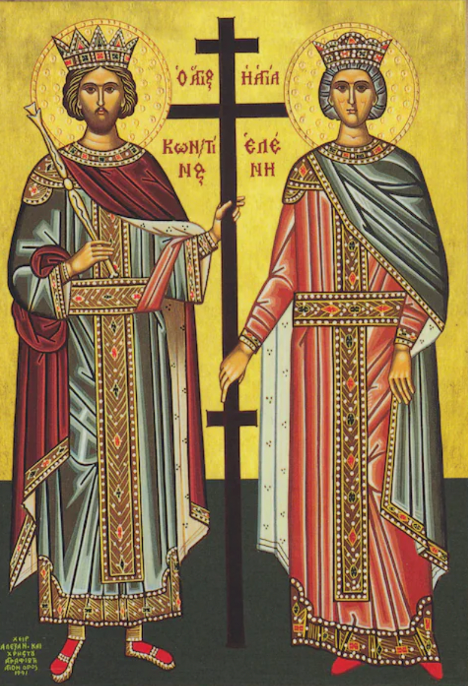
Sts. Constantine and Helen
Sts. Constantine and Helen, Equal to the Apostles | May 21
By: Rev. Dennis Michelis From: “The Champions of the Church”
As we long since perceived that religious liberty should not be denied, but that it should be granted to each one to perform divine duties according to his own determination, we had given orders, that each one, and the Christians among the rest, ‘have the liberty to observe the religion of his choice, and his peculiar mode of worship.. . Therefore, we have decreed the following ordinance, as our will, with a salutary and most correct intention, that no freedom at all shall be refused to Christians to follow or to keep their observances of worship ... And this we further decree with respect to the Christians, that the places in which they were formerly accustomed to assemble ... these shall restore them to the Christians.
If the language of the above excerpts from an imperial edict seems a little confusing to us today, it was most clear to the ancient Christians who heard the order read to them. How joyously they received the message and its content! The above edict which was decreed by Emperor Constantine the Great in Milan in A.D. 311, proclaimed the granting of toleration to the Christian religion, and, therefore, the cessation of all persecutions.
Constantine--the son of Constantios Chloros--emperor of the Western territories of the Roman Empire, having succeeded his father as emperor, thought the time was ripe to give the Christian Church legal status. So, together with Licinius, emperor of the Eastern territories, he issued the above edict. Later, when Licinius turned against Constantine, the armies of the two heads of state met at Adrianople where Licinius was totally defeated.
The defeat of Licinius left Constantine as the sole emperor of the empire. Alone, he could now proceed as he pleased. He made administrative reforms, lavished Rome and other cities with public works, and on the site of Byzantium, he built a new capital which he named New Rome. Later, his people named it the City of Constantine (Constantinopolis) Constantinople in order to honor him.
It was the Church, however, that really benefited during his reign. Christian priests now enjoyed the same privileges as their pagan counterparts and witchcraft was outlawed. Christians were not obliged to participate in pagan festivals. Sunday was declared a day of rest, and the Church could now build its own houses of worship.
At the same time, his pious mother Helena directed excavations in Jerusalem with the hope of finding the Cross of Jesus. She did find it, and, together with her son, saw to it that churches would be built in Bethlehem, Jerusalem, Constantinople and Rome.
Constantine postponed his baptism--as was customary in his day--until he lay on his deathbed. Although he remained technically a pagan until just prior to the end of his life, he did not hesitate to grant the Church and her people legal status and privileges hitherto nonexistent. Why? Because in his superb judgment, he had correctly recognized that Christ was the only true God and Savior. Moreover, his conferring of legal status on the Church put an end to the senseless persecutions that for two and half centuries had been periling the Church.
He died at his summer palace at Nicomedia. With honors never hitherto shown to a previous ruling monarch, his body was brought to Constantinople where it was laid to rest in the church of the Holy Apostles.
In recognition of all that he did for the Church and its peoples, Constantine and his mother were canonized, and are known as “Isapostoloi,” that is, “Equal to the Apostles.”